
Is there any way to make our kids have a positive attitude toward school? Do kids need homework, or should we start to question its role if kids hate it so much? This article looks at the common reasons behind children’s struggles with school and home assignments. It provides science-based guidelines for parents and actionable solutions that can help a kid doing homework better cope with the stress and frustration related to their after-school learning tasks.
Why Do Kids Need Homework?
Do kids need homework? There’s a big debate on whether homework is important for enhancing learning or an unnecessary burden on children. Should the response of schools be modeled by parents’ and students’ interests and attitudes toward the assigned tasks? What does a kid doing homework take from the experience?
When making adjustments, should we consider quantity or quality? Specialists recommend 10 minutes of daily homework per grade level. This means that a sixth grader should get close to 1 hour of after-school study. The volume of homework is sometimes greater than that starting with primary school.

Regarding quality and purpose, The American Federation of Teachers claims that homework should not be assigned for uncompleted seatwork or as a punishment for not paying attention in class. It should be interesting and relevant and reinforce skills already taught.
On a simpler analysis, one cannot overlook the skills and positive habits that homework is meant to enhance. When having a regular study routine, children develop superior reasoning and independent problem-solving skills. They learn about responsibility, time management, autonomy in finishing a task, and accountability.
So the simple answer to the question “Do kids need homework?” is YES. They benefit from a structured study routine. Besides that, homework reinforces what was taught in class and teaches important life skills like responsibility, time management, and problem-solving.
👉 Curious about why being your child’s friend might backfire? Learn why it’s important to set boundaries in parenting. Check out our article for eye-opening insights: Setting Boundaries in Parenting: Why Parents Should Not Be Friends with Their Child.
Challenges Faced by the Kid Doing Homework – Why Do Kids Hate Homework?
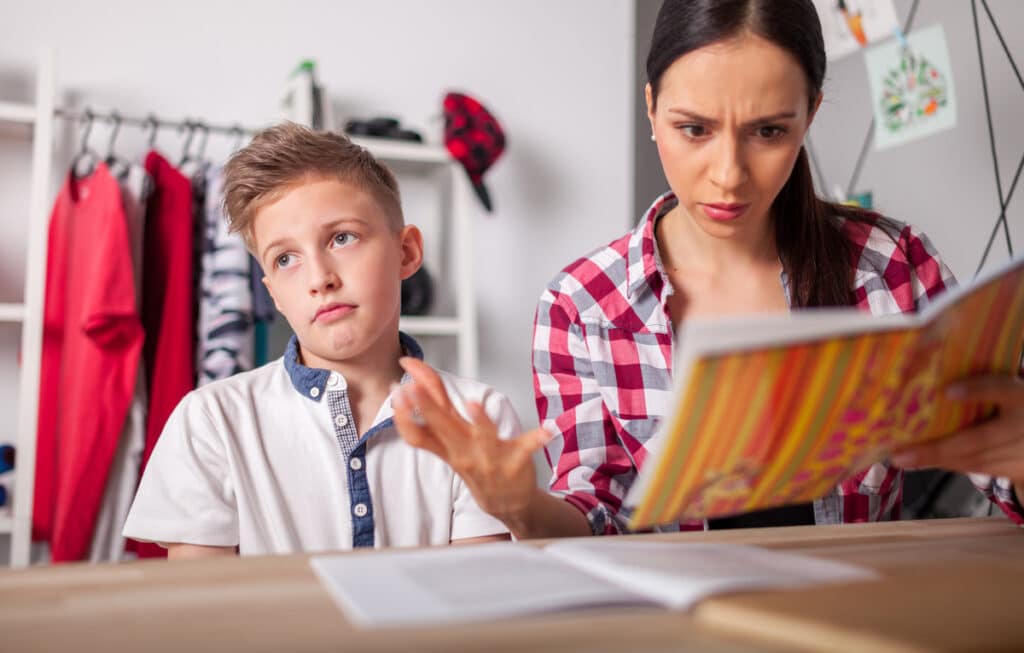
Just mention this “H” word, and you’ll see children’s facial expressions change. Some parents try to creatively rename “homework” or “chores” because the aversion to these words can make children refuse to collaborate from the get-go.
Here are some reasons why you see a lot of frowns in a kid doing homework:
- Adults’ attitude toward homework: You know it. A refusal from your kid, and things get dramatic. We punish, take away benefits, and try everything in our toolbox to convince them to do their homework. The message we send is: ‘Your schoolwork is more important to me as your parent.’ Not far from that is their answer: ‘Then why don’t you do it?’ Inner motivation for learning can be sabotaged when force or blackmail is involved.
- Learning difficulties: Sometimes, the task given is too difficult for their abilities. Kids in school are usually being evaluated by the same standards. It might happen for moderate learning difficulties to go unnoticed. Vision problems, speech problems, dexterity issues, or insufficiently developed literacy or numeracy skills are only a few examples. Why do kids hate homework? When adding pressure and not empathy to decrease these differences, kids can lose their interest in school. They just give up.
- The lack of resources: Doing homework is not the same for all students. Not all have the same resources to learn. A 2021 study by the University of California showed that children of higher income are more likely to excel at home assignments due to their learning environment. Most of them use computers for research, get more help from their parents, or study with tutors. That points to a great disadvantage for kids in low-income families. Not only do they not have access to these resources, but they often receive afterschool responsibilities around the house that don’t center around school or learning. For example, having to care for little brothers, sisters, or older family members.
- Picked-up behavior: Talks about the dreaded task of doing homework are widespread between friends and in school. It’s a trend. Sometimes, it’s not about the nature of homework – as some kids might enjoy doing some of the assigned projects – but about becoming a pack member. A kid doing homework is seen as uncool—the school geek. Not many hands are risen for that role.
Strategies to Help Kids Overcome Homework Challenges
A child’s attitude regarding homework can be improved when considering a few important factors. Are they in a good place emotionally? Do they feel appreciated for their school results? Is the space in which they do their homework comfortable, well-lit, and dedicated for them in the time they work? Do they have access to information, or do they get help when they need it? Do they know how to use their time effectively? Here’s what you can do to ease the stress in a kid doing homework:

1. Create an Optimal Homework Environment
New skills are better acquired and information better retained when kids are comfortable in their learning environment. Having a designated space for homework, even if not an entire room, can make tasks more engaging and keep kids more focused. Here are a few tips:
- Think of Investing in ergonomic furniture: An adjustable workspace is not just practical. It can increase comfort and the ability to focus for a kid doing homework. It helps them keep a healthy posture while working. Chairs and tables that have adjustable height, an armrest, and back support can reduce wrist and shoulder strain and improve circulation. Adjustable ergonomic furniture could also prove cost-effective because it “grows” with the child. Discourage working on the bed. It’s not only bad for their posture, but it might make them lose their focus. Beds are usually associated with rest, and that could kill their productivity.
- Encourage kids to keep their workspaces clutter-free: To prevent interruptions, supplies have to be accessible. Use boxes or drawers to keep pens, pencils, work papers, craft tools, and other materials organized.
- Teach them to use technology wisely: A kid doing homework on their tablet? This can actually be a good idea. Kids are tech-savvy from an increasingly younger age. Technology is a great resource for learning while also preparing children for the future. It can increase engagement and create independent learners. When having visual support and captivating feedback, math, spelling, or reading become more fun. Most apps provide parents and teachers with reports on the child’s progress and areas that need to be improved.
- Minimize distractions: To help your child concentrate, make sure that visual stimuli and surrounding noises are minimal. Keep the working space free of toys or gadgets that are not specially designed for learning. Get younger siblings occupied so they don’t disturb the kid doing homework.
2. Use The Power of Positive Reinforcement
Among other things, inner motivation is activated when kids feel appreciated for their achievements. Thoughtful praise or words of encouragement can go a long way for a kid doing homework. A literature review published in the Scientific World Journal in 2012 showed that phrasing is also very important. Highlight the process more often than praising the result: ‘You’ve worked so hard on that assignment, I saw you struggle a bit midway, but that idea you got on how to solve it proved effective.’ could be more rewarding than ‘Way to go, you did it, you’re so smart.’

This can help kids focus on the process they use for problem-solving and transfer the learning to another situation. Empty praise has the opposite effect. It makes kids focus on getting an acceptable result while not paying much attention to the process that got them there. Their eyes are on the prize, your validation.
3. Teach Him Time Management Techniques for Kids
Good time management is essential in all families. Hectic schedules are the source of many family conflicts, and those around homework are not an exception. Efforts should be driven toward teaching your child how to prioritize and stay on task. Here are some techniques that could work:
The Pomodoro Technique: This time management technique was developed by an Italian student in the ‘80. It emphasizes four sessions of timed focused work, broken by 5-minute breaks. Each session lasts for 25 minutes. After the 4 sessions, a longer 15-30 minute break completes the cycle. A recent study published in the International Research Journal of Management, IT & Social Sciences claims that using this method could yield better retention and performance in students than lectures.
Show them how to prioritize better: Sometimes, a kid doing homework could choose to start with the tasks that are in their comfort zone. It could be a good strategy to get things going, but it could also mean postponing tasks that are more urgent. Teach them to work with schedules and to recognize and prioritize urgent and important tasks first. Help them keep track and sort assignments by their due date.
👉 Struggling with getting your kid to do homework? Being a permissive parent might be the reason. Find out why in our article on “The Impact of Permissive Parenting on Child Development.” Don’t miss it!
Help them break the tasks into smaller ones: A big assignment can feel overwhelming. Not understanding some relevant concepts that need to be used for a particular type of homework can make children check out. Start by helping them pinpoint the area that is most difficult. Ask them to research that piece of information or offer to explain it yourself. Then suggest splitting the remaining work into smaller steps. Encourage them to think of 4-5 steps that need to be followed. With breaks in between if necessary.
Mistakes Parents Should Avoid If Their Kid Hates Homework
Are you wondering: ‘Why do kids hate homework?’ Sometimes we pave that road with our overreaching standards, inflexibility, and the methods we use to motivate them. Here are three common mistakes parents should avoid:
- Comparing kids to their peers: The last thing a kid doing homework wants to hear is how much better or faster their siblings or peers do when completing similar tasks. When comparison is frequently used to motivate a child, they can lose their interest in pushing themselves harder. Use positive reinforcement as often as you can. See and appreciate them for who they are. Focus on their strengths. Self-esteem is a good internal motivator for improving performance.
- Not allowing breaks: Kids are easily distracted. It’s not uncommon to see a kid doing homework leave their desk for water, snacks, or play. While these interruptions could break their focus, they could also point to the fact that they need a brain break. Before sending them back to work, you should consider their attention spans. For example, guidelines mention that a 9-year-old’s attention span is around 20 to 30 minutes. A homework session could last for a few hours sometimes, so allowing 10-15 minute breaks and space to move is advised. Show them how to set timers so they return on time.
- Homework became transactional: Children need to see the purpose in doing something that is too hard or too boring, as a kid doing homework might sometimes say. Rewards, punishments, or bribes make it an outer constraint. It encourages them to negotiate for a bigger reward or lie to avoid punishment. The learning and skill-building goal of homework takes the back seat while power struggles around doing it or not or for what price becomes more important. It is usually mandatory to turn in the homework that was assigned, so there is not too much room for negotiation. This is why the efforts should rather go toward kindly and patiently supporting the process by offering resources and helping them get unstuck.
Conclusion
Homework assignments are not designed to please our kids in the first place. While learning can also be fun, and the methods we use to teach them can be adapted to suit their rhythms, a kid doing homework will always feel some amount of frustration and stress.
Schoolwork is designed to improve skills, grow responsibility, and teach other important life skills related to time management and problem-solving. The growing pains of getting new abilities are real, but so are the benefits that come from overcoming challenges. Do kids need homework? Yes. Can we do something to make it easier? Yes. The science-based strategies and insights in this article could improve your child’s attitude toward homework and also your relationship.
Hungry for more? Join our next online event, Why your kid hates school: 5 steps to get your kid to do homework and love learning to ease the stress that comes with learning difficulties and school assignments for both you and your child.
Our friendly AI assistant, Sophie, is available 24/7 to answer your most pressing questions about childcare and parenting-related issues.
References
American Federation of Teachers. (n.a). Assigning effective homework. https://files.eric.ed.gov/fulltext/ED516934.pdf
Drexel University. (n.a). How to use technology in the classroom. https://drexel.edu/soe/resources/student-teaching/advice/how-to-use-technology-in-the-classroom/
Grinshtain, Y., & Harpaz, G. (2021). Whose Homework Is It? The Elementary School Journal. https://doi.org/10.1086/716639
Kohn, A. (2006). The homework myth: Why our kids get too much of a bad thing. Da Capo Press.
Lathan, J. (n.a). Is Homework Necessary? Education Inequity and Its Impact on Students. University of San Diego. Accessed on February 26th, 2024. https://onlinedegrees.sandiego.edu/education-inequity-and-homework/
F. Law, B. M., H. Siu, A. M., & L. Shek, D. T. (2012). Recognition for Positive Behavior as a Critical Youth Development Construct: Conceptual Bases and Implications on Youth Service Development. The Scientific World Journal, 2012. https://doi.org/10.1100/2012/809578
Santiago, C., & Gurat, M. (2023). The Effect of Pomodoro Technique on Student Mendelian Genetics Concept Mastery during Synchronous Remote Learning. International Research Journal of Management, IT & Social Sciences, 10(4), 233-243. https://doi.org/10.21744/irjmis.v10n4.2287
Stadler-Altmann, U. (2015). Learning Environment: The Influence of School and Classroom Space on Education. The Routledge International Handbook of Social Psychology of the Classroom pp. 252-262 https://www.researchgate.net/publication/282348767_Learning_Environment_The_Influence_of_School_and_Classroom_Space_on_Education